Choosing a hat manufacturer in China can feel risky, especially for a first order. Prices look similar, and every supplier says they offer top quality. So how do you tell a real factory from a trading company? Moreover, how do you avoid delays, sample surprises, and quality problems?
This guide gives you a clear, practical checklist. First, you will learn what to check before you contact anyone. Next, you will see which questions to ask and which red flags to watch. Finally, you will get a simple scorecard to compare suppliers side by side.
Quick Answer: How Do You Choose a Hat Manufacturer in China?
To choose a good hat manufacturer in China, check six things. Confirm it is a real factory, not only a reseller. Then check that it makes your hat style every week. Also order real samples before you pay for bulk. After that, compare MOQ, lead time, and total landed cost. Finally, agree on quality checks and trade terms in writing.
Why Source Hats From China in 2026?
China remains one of the largest hat-making regions in the world. Factories there have deep supply chains for fabric, straw, trims, labels, and packaging. As a result, one supplier can often handle your whole order in one place.
Cities such as Yiwu are also major sourcing hubs. For example, the Yiwu International Trade City is one of the largest wholesale markets for small goods. In addition, Yiwu sits close to Ningbo and Shanghai ports. Because of this, shipping options are wide and freight is easier to book.
However, China is not the only option. Vietnam and Bangladesh are growing fast, too. Still, China usually wins on material choice, style range, and speed of sampling. That matters most when you want many styles in one order.
Factory vs Trading Company: Know Who You Are Talking To
This is the first and most important check. A factory owns the machines and employs the workers. A trading company buys from factories and sells to you. Neither is always bad. But you should know which one you are dealing with.
| Point | Hat Factory | Trading Company |
|---|---|---|
| Price | Usually lower, no middle margin | Often higher to cover their margin |
| Control over quality | Direct control on the line | Depends on the factory they use |
| Style range | Deep in the styles they make | Wide, but spread across many factories |
| Custom changes | Fast, because the pattern room is in-house | Slower, since requests are passed on |
| Best for | Brands that want steady repeat orders | Buyers who need many unrelated items |
So how do you check? First, ask for a live video call during work hours. Next, ask to see the sewing lines, embroidery machines, and packing area. Also check the business license. Then compare the company name on the license with the name on the invoice.
Step 1: Match the Factory to Your Hat Style
Not every hat factory makes every hat well. For example, a baseball cap line needs different skills from a straw hat line. Caps need panel cutting, crown shaping, and embroidery. Straw hats, on the other hand, need braiding, blocking, and brim finishing.
Therefore, ask each supplier one simple question. “Which hat styles do you make every week?” Then compare their answer with your product list.
Common hat styles to ask about include:
- Baseball caps: washed, distressed, dad hats, and snapbacks
- Bucket hats: corduroy, tie-dye, printed, and reversible
- Straw hats: Panama, cowboy, beach, wheat straw, and crochet
- Pet hats: birthday, cowboy, straw, and Santa hats with ear holes
- Mini and doll hats: top hats, sombreros, and mini straw hats for crafts
A good test is to ask for photos of a style you already sell. For instance, a factory making an embroidered baseball hat every week will quote faster. Also, its first sample will usually be closer to what you want.
Step 2: Prepare a Clear Hat Spec Sheet
Good suppliers can only quote well when your request is clear. So send a short spec sheet with your first email. It saves days of back-and-forth messages.
Your spec sheet should include:
- Hat style and reference photos
- Material and color (Pantone codes help)
- Head size range, such as 56 to 60 cm
- Logo method: embroidery, patch, print, or woven label
- Logo size and position on the hat
- Inner labels, hang tags, and packaging needs
- Target quantity per style and per color
- Target delivery date and shipping country
Not sure how to put this together? Our OEM & ODM ordering process walks through each step, from sample to shipment.
Step 3: Understand MOQ and How It Changes Price
MOQ means minimum order quantity. It is the smallest number of pieces a factory will make per order. Often, MOQ is set per design and per color.
MOQ matters because it drives your unit price. Larger runs spread setup costs across more hats. So the price per piece usually drops as quantity goes up. However, a very low MOQ can mean a higher unit price. That trade-off is normal.
When you compare quotes, ask these questions:
- Is the MOQ per style, per color, or per whole order?
- Can I mix colors to reach the MOQ?
- Does custom fabric or a custom label raise the MOQ?
- What are the price breaks at higher quantities?
Also, ask if blank stock hats are available. Blank hats can let you test the market with a smaller first order. For a deeper look, read Hat MOQ and pricing FAQ.
Step 4: Always Order Samples First
Never skip samples. Photos can look perfect, but real hats show the truth. A sample lets you feel the fabric, check the fit, and test the stitching.
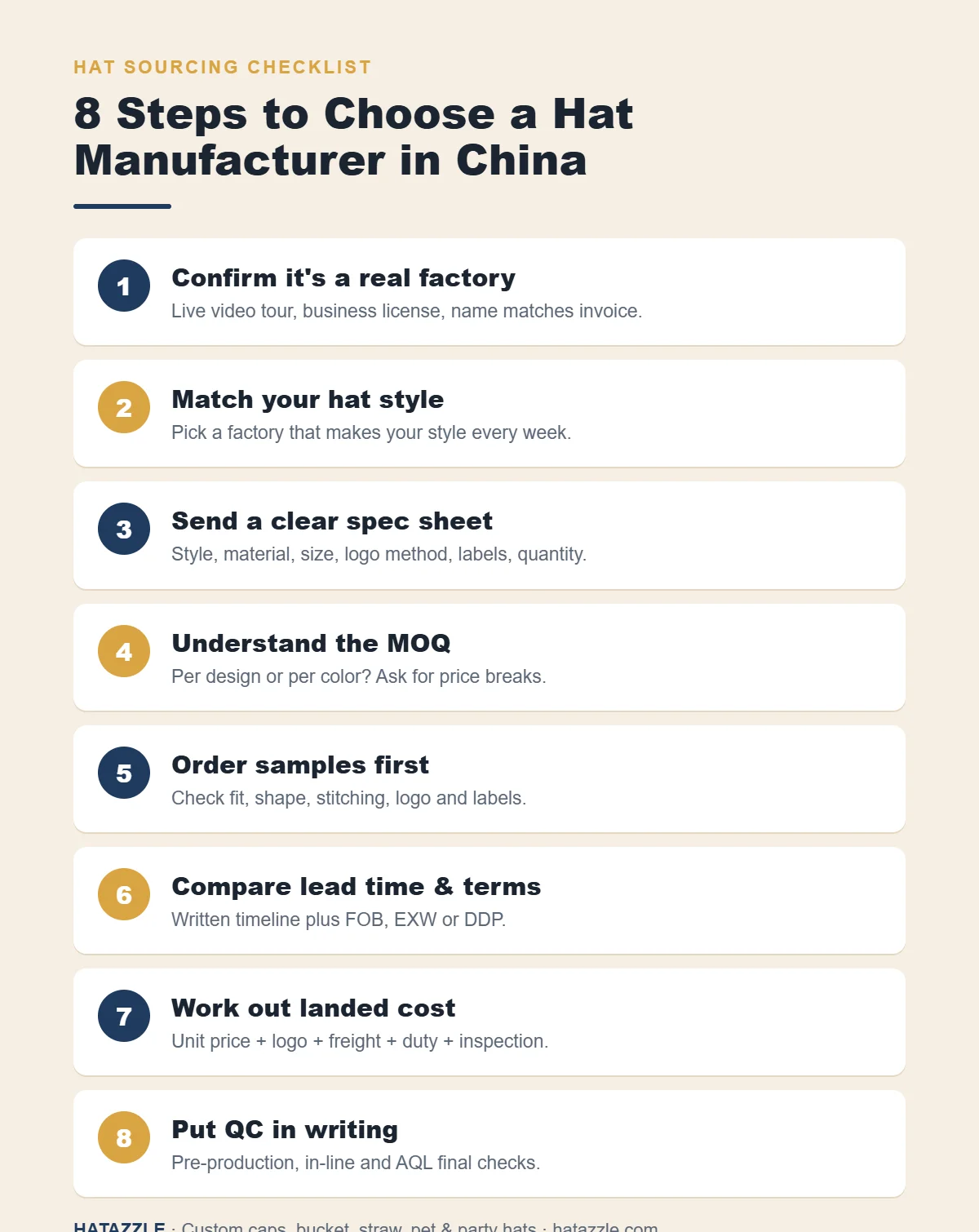
Here is what to check on every sample:
- Size and fit: measure the head size and compare it with your size chart.
- Shape: check that the crown holds its shape and the brim sits evenly.
- Stitching: look for loose threads, uneven lines, or skipped stitches.
- Logo: check embroidery density, print sharpness, and position.
- Labels and trims: confirm the sweatband, inner label, and closure.
Many factories offer free samples for standard styles. For custom designs, a sample fee is common. Often, that fee is refunded once you place the bulk order.
Straw hats need extra checks. For example, look at the weave for gaps and check that the brim does not bend too easily. A classic style like our Panama straw hat for sun protection is a good benchmark for weave quality.
Step 5: Check Materials and Customization Options
The material shapes the look, the comfort, and the price. So talk about fabric early, not after the sample.
| Hat Type | Common Materials | Popular Custom Options |
|---|---|---|
| Baseball caps | Cotton twill, washed cotton, polyester, corduroy | 3D embroidery, patches, printed labels |
| Bucket hats | Cotton, corduroy, nylon, printed fabric | All-over print, reversible design, woven labels |
| Straw hats | Paper straw, wheat straw, raffia, toquilla | Printed bands, leather patches, custom shapes |
| Pet and mini hats | Felt, straw, cotton, plush | Ear holes, elastic straps, custom colors |
Also ask about packaging. For example, you may want polybags, hang tags, or boxes with your brand name. Good OEM factories handle this in-house, which saves time.
Planning to sell under your own brand? Then it helps to know the difference between service types. See our OEM & ODM hat services before you sign.
Step 6: Compare Lead Time, Trade Terms, and Shipping
Lead time is how long production takes after you approve the sample. It depends on the style, the quantity, and the season. For instance, straw hat demand peaks before spring and summer. So factories get busy early in the year.
Therefore, plan ahead. Ask each supplier for a written timeline that covers:
- Sample making time
- Bulk production time
- Quality check and packing
- Shipping time by sea, air, or express
Next, agree on trade terms. Terms such as FOB, EXW, and DDP set who pays for each part of the journey. They also set when risk moves from seller to buyer. The official Incoterms rules from the International Chamber of Commerce explain each term in detail.
| Season | Hats in High Demand | When to Place Orders |
|---|---|---|
| Spring and summer | Straw hats, bucket hats, sun hats | Late autumn to early winter |
| Autumn and winter | Caps, corduroy styles, holiday pet hats | Late spring to summer |
| Events and festivals | Party hats, cowboy hats, sombreros | Two to three months before the event |
Step 7: Work Out the Total Landed Cost
The unit price is only one part of your cost. So compare the full landed cost, not just the factory quote. Landed cost is what one hat costs once it reaches your warehouse.
Add up these costs for each supplier:
- Unit price for the hat
- Logo, label, and packaging costs
- Sample fees, if any
- Freight, insurance, and port charges
- Import duty and customs fees in your country
- Inspection cost, if you use a third party
Sometimes a slightly higher unit price wins. For example, a factory with better packing may lower your damage rate. As a result, your real cost per sellable hat can be lower.
Step 8: Agree on Quality Control in Writing
Quality problems cost more after shipping. So agree on checks before production starts. A simple three-stage plan works well.
- Pre-production check: confirm fabric, color, and trims match the approved sample.
- In-line check: inspect hats during production to catch errors early.
- Final check: inspect a random batch before packing and shipping.
Many buyers use AQL sampling for the final check. AQL sets how many hats to inspect and how many defects are acceptable. It is based on the ISO 2859-1 sampling standard. You can also hire a third-party inspection company. Moreover, ask the factory to send photos and a short video before shipping.
Red Flags to Watch For
Some warning signs appear early. Watch for these before you pay a deposit:
- The supplier refuses a video call or factory tour.
- The price is far below every other quote.
- They say yes to every style, fabric, and deadline without questions.
- The bank account name does not match the company name.
- They push for full payment before any sample is approved.
- Replies are slow, vague, or keep changing.
One red flag is not always a deal-breaker. However, two or three together are a strong reason to walk away.
Questions to Ask a Hat Manufacturer Before You Order
Use this list in your first email or call. Their answers will show you a lot.
- Are you a factory or a trading company?
- Which hat styles do you produce every week?
- What is your MOQ per design and per color?
- Do you offer free samples, and how long do samples take?
- Can you make custom labels, tags, and packaging?
- What is the bulk lead time for my quantity?
- How do you check quality before shipping?
- Which trade terms do you offer, such as FOB or EXW?
- Which markets do you already ship to?
- What payment terms do you accept?
Supplier Scorecard: Compare Hat Factories Side by Side
Score each supplier from 1 to 5 on each point. Then add up the totals. This keeps your choice fair and simple.
| Criteria | What “5” Looks Like |
|---|---|
| Factory proof | Live video tour, license matches, real production lines |
| Style match | Makes your exact hat type every week |
| Sample quality | Sample matches your spec on first or second try |
| MOQ and price | Clear price breaks, flexible MOQ |
| Lead time | Written timeline that fits your launch date |
| Communication | Fast, clear replies in good English |
| Quality control | Written QC steps plus pre-shipment photos |
Why Buyers Work With Hatazzle
Hatazzle is the export brand of Yiwu Jucong Hat Factory in Yiwu, China. The team has around 16 years of hat-making experience. Also, the factory sits close to Ningbo and Shanghai ports, which keeps shipping simple.
We make baseball caps, bucket hats, straw hats, pet hats, doll hats, mini hats, and party hats. In addition, we offer full OEM and ODM hat manufacturing and free samples for standard styles. Our buyers ship to North America, Europe, South America, Southeast Asia, and Africa.
Ready to start? Send us your design or reference photo, and we will reply with a quote and sample plan.
Frequently Asked Questions
How do I find a reliable hat manufacturer in China?
Start with suppliers that show real factory proof. Then ask for a video tour, check their license, and order samples. Finally, compare quotes with a simple scorecard.
What is a typical MOQ for custom hats?
It depends on the style and the level of customization. Blank or stock hats often have lower MOQs. Custom fabric, colors, or labels usually raise the MOQ. So always ask for MOQ per design and per color.
Are hat samples free?
Many factories offer free samples for standard styles. For custom designs, there is often a sample fee. Some factories refund it when you place a bulk order.
How long does hat production take in China?
Timing depends on quantity, style, and season. Busy seasons, such as spring for straw hats, can add time. Therefore, ask for a written timeline before you pay the deposit.
Should I choose a factory or a trading company?
A factory usually gives better prices and more control. A trading company can help if you need many unrelated products. For steady hat orders, a direct factory is often the better choice.
Can a Chinese hat factory put my own brand on the hats?
Yes. Most OEM factories add your logo, labels, tags, and packaging. This is called private label or OEM production.
Which trade term is best for a first order?
Many first-time buyers choose FOB. The factory delivers to the port in China, and you control the main freight. However, DDP can be simpler if you want one price to your door.