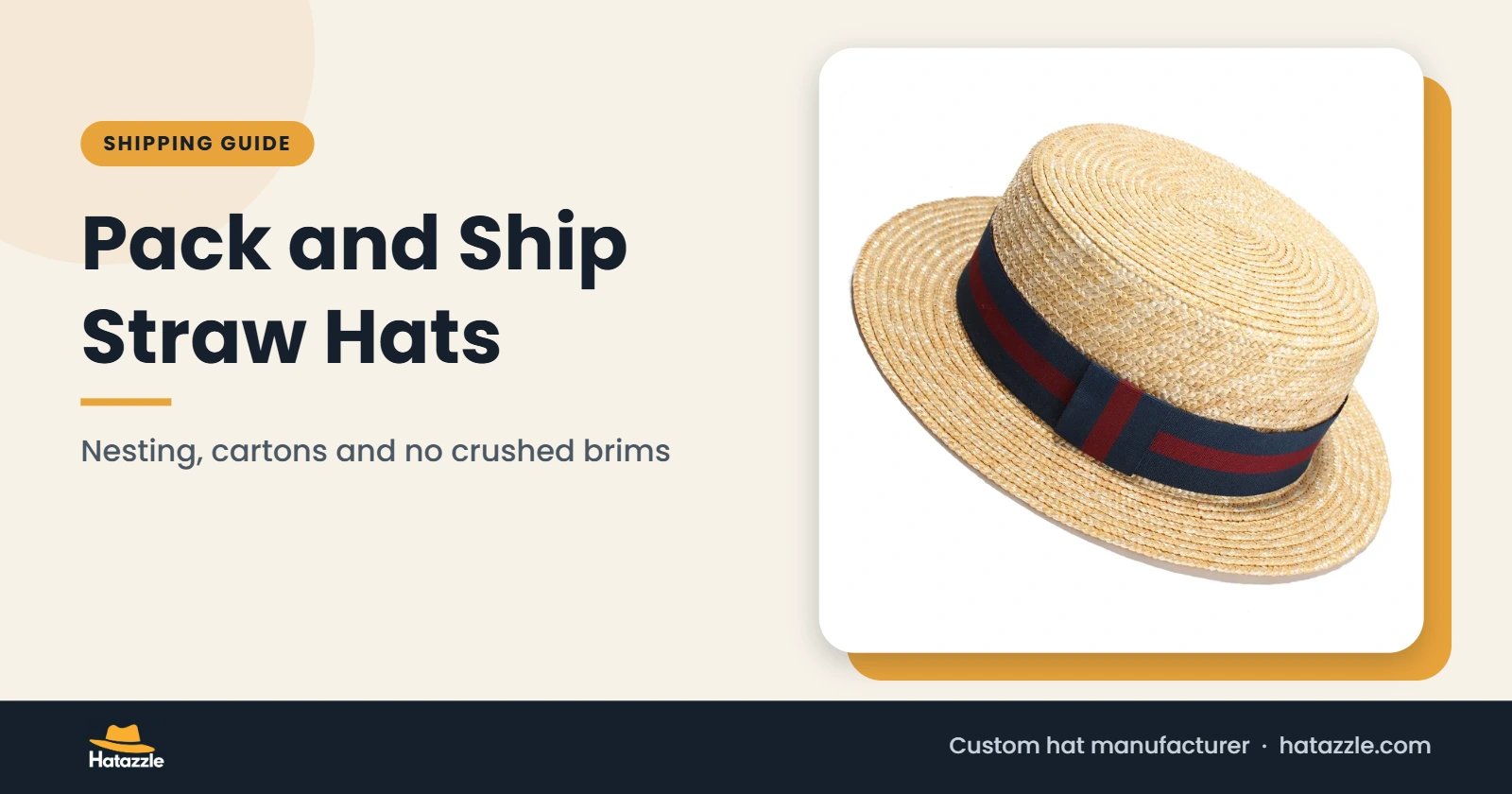
Straw hats are packed for shipping by nesting them inside each other in stacks, supporting the crown so it keeps its shape, and placing the stacks in strong cartons sized so the brims do not bend. Done well, a bulk order of straw hats arrives looking exactly like the sample. Done badly, it arrives with flattened crowns, cracked weaves and wavy brims that no steaming can fully fix.
This guide explains how straw hats are packed for export, which details cause damage in transit and what to agree with your supplier before a bulk order leaves the factory. It is written for retailers, resorts, event buyers and brands importing straw hats in quantity.
Quick Answer: How Are Straw Hats Packed for Shipping?
Most straw hats are shipped nested: one hat sits inside the next, crown into crown, to form a neat stack. Tissue paper or a light insert supports the crown, each stack may be wrapped in a polybag, and the stacks go into cartons that are wide enough for the brim to lie flat. Hats with stiff shapes, heavy trims or very wide brims may need their own boxes or dividers.
Why Straw Hats Get Damaged in Transit
Straw is light, but it is not elastic. Once a straw weave is bent sharply, it often keeps the crease. The most common causes of damage are simple:
- Cartons that are too small. If the carton is narrower than the brim, the brim curls up the sides and keeps that shape.
- Too many hats in one stack. Very tall stacks put pressure on the bottom crowns.
- Weak cartons. Soft cardboard collapses when cartons are stacked on a pallet or in a container.
- Heavy trims. Bows, chains and large badges press into the hat below.
- Moisture. Damp air during a long sea journey can soften straw and leave marks or odour.
Most of these problems are decided at the factory, before the carton is sealed. That is why packing should be part of your order specification, not an afterthought.
Packing Methods Compared
| Method | How it works | Best for | Watch out for |
|---|---|---|---|
| Nested stacks | Hats sit inside each other, crown into crown | Most boaters, sun hats, cowboy and Panama styles | Stack height and trims pressing on the hat below |
| Nested with crown support | Tissue or a paper insert inside each crown | Hats with softer weaves or tall crowns | Ask what support material is used |
| Individual boxes | One hat per box, often with a printed lid | Premium ranges, gifts, structured shapes | Higher carton volume and freight cost |
| Flat or folded packing | Hats that are designed to fold or roll | Packable and crochet styles only | Never fold a hat that is not made for it |
How Nesting Works
Nesting is the standard method for good reason. Because each hat supports the next, a stack is far stronger than loose hats. It also saves a great deal of space, which keeps freight costs down. A few rules make nesting safe:
- Only nest hats of the same shape and size in one stack.
- Keep the stack to a height the bottom hat can carry without flattening.
- Turn trims, bows and badges so they sit in the same position on every hat and do not press into the crown below.
- Add tissue between hats when the straw has a delicate finish or a printed band.
Shapes that do not nest well, such as some flat-top styles or hats with very stiff, deep crowns, may need a different method. Our flat top wheat straw hat and bowknot beach straw hat are good examples of how much the shape and trim affect packing.
Choosing the Right Carton
The carton matters as much as the packing inside it. Ask your supplier for the inner size of the carton, not only the outer size, and check it against the brim diameter of your hat. The brim should lie flat with a little space to spare.
For export, a double-wall carton is usually the safer choice, especially for sea freight, where cartons may be stacked high on a pallet or in a container for weeks. Ask how many cartons will be stacked on top of each other and whether corner protectors or pallets are used.
It is also worth asking for the carton weight and dimensions early. Straw hats are light but bulky, so freight is often charged on volume rather than weight. A carton that holds a few more hats without crushing them can reduce your shipping cost noticeably.
Polybags, Tissue and Labels
Inside the carton, small details protect the hats and make them easier to sell:
- Polybags keep dust and moisture away and are often required by warehouses and marketplaces.
- Tissue paper supports the crown and protects printed or coloured bands.
- Carton labels should show the style, colour, size and quantity, so your warehouse can receive the goods quickly.
- Hang tags and barcodes are easier to apply at the factory than after arrival.
If you are selling under your own brand, our private label hat packaging guide explains labels, tags and polybags in more detail.
Protecting Straw From Moisture
Straw is a natural or paper-based material, and it reacts to humidity. On long sea journeys, containers can become warm and damp. To reduce the risk:
- Make sure hats are fully dry before they are packed.
- Ask whether moisture absorbers are added to cartons for sea freight.
- Store cartons off the floor in a dry area when they arrive.
- Open a few cartons straight away and let the hats breathe if they smell musty.
Different straw types behave differently. Paper straw, wheat straw and raffia each have their own strengths, which we compare in our straw hat materials guide.
Air or Sea Freight?
The packing method should match the shipping method. Air and express shipments move faster and are handled more often, so cartons need to be strong and well sealed. Sea shipments take longer and face more humidity and stacking pressure, so carton strength and moisture protection matter most. If your selling date is fixed, such as a summer season or an event, plan the shipping method early. Our seasonal hat ordering calendar helps you work backward from the date you need stock on the shelf.
What to Ask Your Supplier Before Shipping
- How many hats go in each stack, and how many stacks per carton?
- What is the inner carton size, and is it wider than the brim?
- Is the carton single-wall or double-wall?
- Is tissue or another crown support used?
- Are polybags, hang tags and carton labels included?
- Can you send photos of a packed carton before it is sealed?
Photos of a packed carton are one of the easiest and most useful checks you can ask for. Add packing to your pre-shipment checks as well; our hat quality control checklist lists the points to include.
What to Do When the Hats Arrive
Inspect a sample of cartons as soon as the goods arrive. Look for crushed corners, damp patches and brims that have taken on the shape of the carton. Unpack hats carefully and store them on shelves or in their stacks rather than piling loose hats on top of each other. Slightly misshapen brims on many straw hats can be eased back with gentle steam, but deep creases in the weave are usually permanent, so prevention is always better than repair.
Ship Straw Hats That Arrive Like the Sample
Hatazzle is the export brand of China Yiwu Jucong Hat Factory. We make and pack straw hats for retailers, resorts and brands worldwide. Browse our straw hats, read how a custom hat order works, or tell us your style and quantity and we will confirm the packing method, carton size and shipping options with your quote.