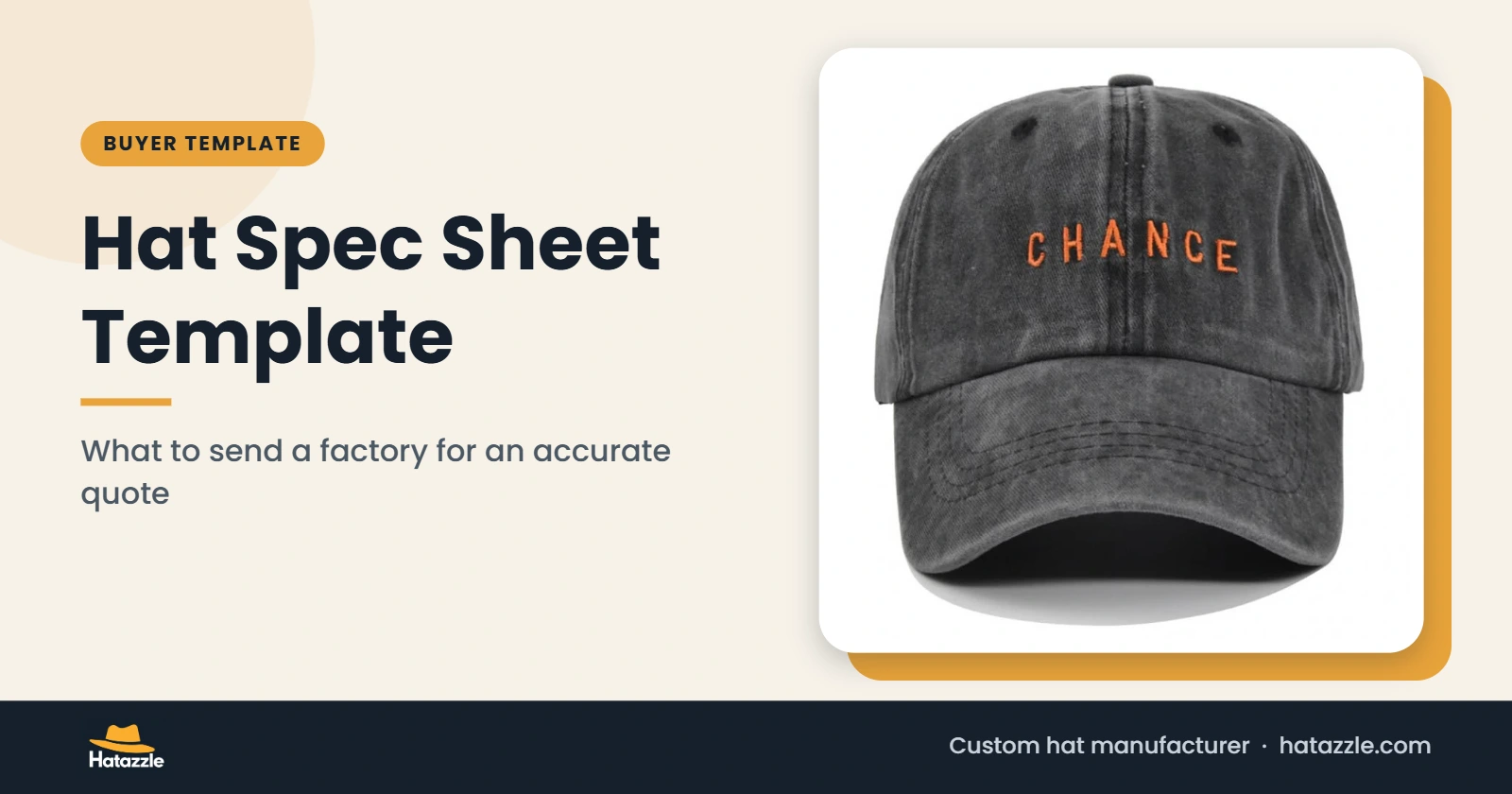
A hat spec sheet is a short document that tells a factory exactly what you want made: the style, fabric, colours, sizes, logo, trims, packaging, quantity and delivery date. A clear spec sheet gets you an accurate quote faster, prevents sampling mistakes and becomes the reference for the whole order. You do not need design software; a simple table and a few reference photos are enough.
This guide explains what to include in a hat spec sheet, gives you a template you can copy and lists the mistakes that most often slow down a quote. It is written for brands, retailers, promotional buyers and first-time importers ordering custom hats.
Why a Spec Sheet Matters
Without a spec sheet, a quote request turns into a long chain of questions and answers. Each round costs a day or more because of time differences, and small details get lost along the way. Two suppliers can also quote very different prices simply because they have imagined two different hats.
A spec sheet fixes this. It gives every supplier the same information, so their quotes can be compared fairly. It also protects you later, because the approved sample and the spec sheet together define what the bulk order must match.
The Hat Spec Sheet Template
Copy the table below into a document or spreadsheet and fill in every line you can. Write “open to suggestions” where you are not sure. That is far more useful to a factory than a blank space.
| Section | What to fill in | Example |
|---|---|---|
| Hat style | Type of hat and reference photo | 6-panel baseball cap, see photo 1 |
| Construction | Structured or unstructured, crown profile, panels | Unstructured, mid profile, 6 panels |
| Fabric | Material, weight or feel, finish | Washed cotton twill, soft hand |
| Colours | Main colour, under-brim, stitching, Pantone codes | Navy, Pantone 19-4013; under-brim navy |
| Brim | Pre-curved or flat, length | Pre-curved, standard length |
| Closure | Strap, snapback, buckle or fitted | Fabric strap with metal buckle |
| Sizes | Adult, child, or measurements in cm | Adult one size, adjustable |
| Logo 1 | Method, position, size, colours | Flat embroidery, front centre, 6 cm wide, 2 colours |
| Logo 2 | Any second logo or detail | Small embroidered mark on back above strap |
| Inside details | Sweatband, woven label, care label | Woven brand label on back seam |
| Packaging | Polybag, hang tag, barcode, carton marks | Individual polybag, printed hang tag |
| Quantity | Total and split by colour and size | 300 pcs: 200 navy, 100 khaki |
| Target price | Price per piece you are aiming for | Around X per piece |
| Delivery | Date needed and destination country | In warehouse in Germany by 1 March |
| Samples | How many samples and where to send them | 1 sample per colour to our office |
How to Fill In Each Section
Style and Reference Photos
Start with the type of hat and attach one or two reference photos. Add a short note to each photo explaining what you like about it, such as “this crown shape” or “this brim curve, but shorter”. Notes stop the factory from copying details you did not want. Use references for shape and feel only, not to copy another brand’s logo or protected design.
Construction
For caps, say whether the front is structured or unstructured, and which crown profile you want. These choices change both the look and how a logo sits. Our guide to structured vs unstructured caps explains the difference.
Fabric and Colours
Name the fabric if you know it, or describe the feel you want: soft, crisp, washed, textured. Give colours as Pantone codes where possible, because “dark blue” means something different to everyone. If you are choosing between fabrics, our bucket hat fabric guide and straw hat materials guide can help.
Logo Details
The logo section is where most quotes go wrong. For each logo, list the method (embroidery, printing, patch), the exact position, the size in centimetres and the number of colours. Attach the artwork as a vector file such as AI, EPS or PDF. If you are unsure which method suits your artwork, see our comparison of custom hat logo options.
Sizes
Say whether you need adult, child or several sizes, and whether the hat is adjustable or fitted. For fitted hats, give a size split. For pet and mini hats, give measurements, because there is no standard size system.
Packaging
List every item you need: woven labels, hang tags, polybags, barcodes and carton marks. Packaging has its own artwork and lead time, so including it in the first request avoids delays later. Our private label hat packaging guide explains the options.
Quantity, Price and Delivery
Give the total quantity and the split by colour and size, because minimums are often applied per style or per colour. A target price helps the factory suggest realistic options. Give the real date you need the goods and the destination country, so shipping can be planned. Our hat MOQ guide explains how quantities and minimums interact.
Common Spec Sheet Mistakes
- No logo size or position. “Logo on front” can mean many different things.
- Colours described in words only. Pantone codes or physical swatches remove guesswork.
- No quantity split. The total alone does not show how the minimum applies.
- Packaging left out. Tags and labels added later can delay shipping.
- Changing details without saying so. Update the spec sheet and send the new version each time.
- Low-quality artwork. Blurry images lead to poor embroidery or print.
Spec Sheets for Different Hat Types
The template works for every hat, but each type has a few extra details worth adding. For straw hats, include the straw type, the crown shape, the brim width and the band or trim, and ask how the hats will be packed so they are not crushed. For bucket hats, note the brim depth, whether the hat is reversible and the stitching on the brim. For pet hats, give the inner opening in centimetres, the strap type and the breeds you are targeting. For mini and doll hats, list both the outer brim and the inner opening, because the opening decides what the hat will fit.
If you are ordering several hat types in one request, give each style its own column or sheet. Mixing details for different hats in one paragraph is one of the quickest ways to end up with a quote that does not match what you had in mind.
Keep One Version of the Truth
Give your spec sheet a version number and a date, and send the updated file whenever something changes. When you approve the sample, confirm that the spec sheet and the sample match, and keep both. If a question comes up during production, the approved sample and the latest spec sheet are what everyone checks against.
What Happens After You Send It
With a complete spec sheet, the factory can usually reply with a quote, suggestions and sample timing much faster. Next comes a sample, your approval, bulk production, inspection and shipping. Our guide on how to order custom hats in bulk explains each stage, and our OEM and ODM service page explains how we help when you only have an idea rather than a finished design.
Send Your Spec Sheet to Hatazzle
Hatazzle is the export brand of China Yiwu Jucong Hat Factory. We make custom caps, bucket hats, straw hats and pet and mini hats for brands and wholesalers. You can browse our embroidered baseball hats for ideas, then send us your spec sheet or even a single reference photo, and we will reply with questions, a quote and sample timing.